


BACK IN STOCK

BACK IN STOCK
Discover our Vanilla Matcha

Guide
Article published on November 13, 2026
In recent years, matcha has experienced a real boom around the world. Long associated with Japanese culture and the tea ceremony, it has gradually found its way into lattes, iced drinks, pastries, and everyday recipes.
This international craze is having an impact on the Japanese industry. Demand is rising rapidly, particularly outside Japan, while the production of tencha—the raw material used to make matcha—remains subject to agricultural, climatic, and human constraints. Several international media outlets have reported on growing tensions regarding the supply of matcha since 2025.[1][2][3] At Milia Matcha, these tensions have not affected our supply and have not led to any price increases.
Historically consumed mainly in Japan, particularly as part of the tea ceremony, matcha has been experiencing significant international growth for several years. This popularity has accelerated particularly since the end of 2024. In April 2025, Le Monde reported a global craze that was creating the risk of a market shortage, with supply lead times lengthening for some businesses.[1] The Guardian also reported a sharp increase in international demand, exceeding Japan’s production capacity.[2]
This increase directly affects tencha, the green tea used as the raw material for matcha production. According to Reuters, Japan produced 5,336 metric tons of tencha in 2024, more than double the volume recorded about a decade earlier.[3] However, despite this growth, available volumes are struggling to keep pace with rising international demand. The market is thus facing a growing imbalance between supply and consumer demand, rather than an actual disappearance of matcha.
Matcha production relies on the cultivation of tencha, which requires specific methods, includingshading the tea plants before harvest. Increasing production volumes therefore requires new plantations, suitable land, and processing equipment, as well as time and specific agricultural expertise.
According to Reuters, newly planted tea trees may take about five years to yield their first harvests.[3] An increase in production therefore cannot immediately meet the rise in demand.
In addition, the Japanese tea industry is also facing an aging workforce and a decline in the number of farmers. In 2025, *Le Monde* noted that generational renewal was a major challenge for sustaining agricultural production in Japan.[1]
Like all agricultural production, tea depends on weather conditions. Temperatures, precipitation, and heat waves can affect the development of young shoots and harvest volumes. In 2025, Reuters reported that a heat wave had affected harvests in the Kyoto region, one of Japan’s main tencha-producing areas.[3] When supply is already limited, these weather-related uncertainties can exacerbate supply pressures by reducing available volumes from one harvest to the next.
Rising global demand, combined with production that is struggling to keep up, is putting pressure on prices and supply conditions. In April 2025, *Le Monde* reported, in particular, that some professionals in Paris were experiencing longer delivery times.[1] A few months later, Reuters reported that tencha prices were reaching record highs at certain auctions in Japan. At an auction held in Kyoto in May 2025, the price of tencha reached 8,235 yen per kilogram, a 170% increase over the previous year.[3]
However, these increases do not affect all matcha in the same way. Prices and availability vary, in particular, depending on origin, producer, cultivar, and the desired quality. It is therefore more accurate to speak of supply constraints for certain types of matcha rather than a general increase in the price of all matcha.
To create our entire product line, we have chosen to work exclusively withOkumidori, a rare Japanese cultivar prized for its natural sweetness, lack of bitterness, and deep green color. All of our matcha comes from Mie Prefecture in Japan, where we partner with an independent producer who is the heir to a family-owned plantation that has been passed down for over 60 years.
Further Reading
Our matcha
This direct partnership allows us to work with a single producer, without having to rely on multiple sources of supply. From growing the leaves to harvesting, processing, and canning them, every step is rigorously monitored. This ensures complete traceability and quality control at every stage of production.
Learn more
Why choosing a good matcha cultivar is important
In response to rising international demand, the Japanese tea industry is seeking to expand its tencha production. However, this expansion is gradual and depends on several factors: available land, climatic conditions, and the next generation of producers.[3] The challenge, therefore, is to meet growing demand while preserving agricultural expertise and the quality of Japanese teas.
The current tensions in the matcha market serve as a reminder that its production relies on a demanding agricultural supply chain, specific expertise, and time-consuming cultivation cycles. In this context, knowing the origin of your matcha, the cultivar used, and the producer who grows it takes on greater significance. It also provides a better understanding of the value of this Japanese tea and the work involved in its production.
Frequently Asked Questions
Global demand for matcha is growing rapidly, while Japanese production is struggling to keep pace. This situation is exacerbated by the aging farming population, climatic constraints, and the time required to develop new plantations.
Growing tencha requires specific conditions, including shading the tea plants, as well as specialized agricultural expertise. In addition, it can take about five years for new tea plants to produce their first harvests suitable for use.
Supply constraints may lead to higher prices for tencha and certain types of matcha, but not all varieties are affected to the same extent. Prices vary depending on factors such as origin, cultivar, producer, and the desired quality.
No, availability varies depending on producers, origins, and available volumes. Some supplies may remain stable despite the market tensions.
At Milia Matcha, all of our matcha is made from the Japanese Okumidori cultivar and comes from a single farm located in Mie Prefecture, Japan. Thanks to this direct partnership with our producer, our supply remains secure, and we have not passed on any price increases related to the current tensions.
[1] Le Monde, “Matcha, Too Popular, Faces Shortages,” April 30, 2025.
https://www.lemonde.fr/economie/article/2025/04/30/le-matcha-trop-populaire-risque-la-penurie_6602017_3234.html
[2] The Guardian, “‘Skyrocketing’ demand for matcha raises fears of a shortage in Japan,” April 5, 2025.
https://www.theguardian.com/food/2025/apr/05/skyrocketing-demand-for-matcha-raises-fears-of-shortage-in-japan
[3] Reuters, “Japan’s heat-stressed matcha tea output struggles to meet soaring global demand,” July 4, 2025.
https://www.reuters.com/business/japans-heat-stressed-matcha-tea-output-struggles-meet-soaring-global-demand-2025-07-04/

Ceremonial Matcha
White chocolate
30G
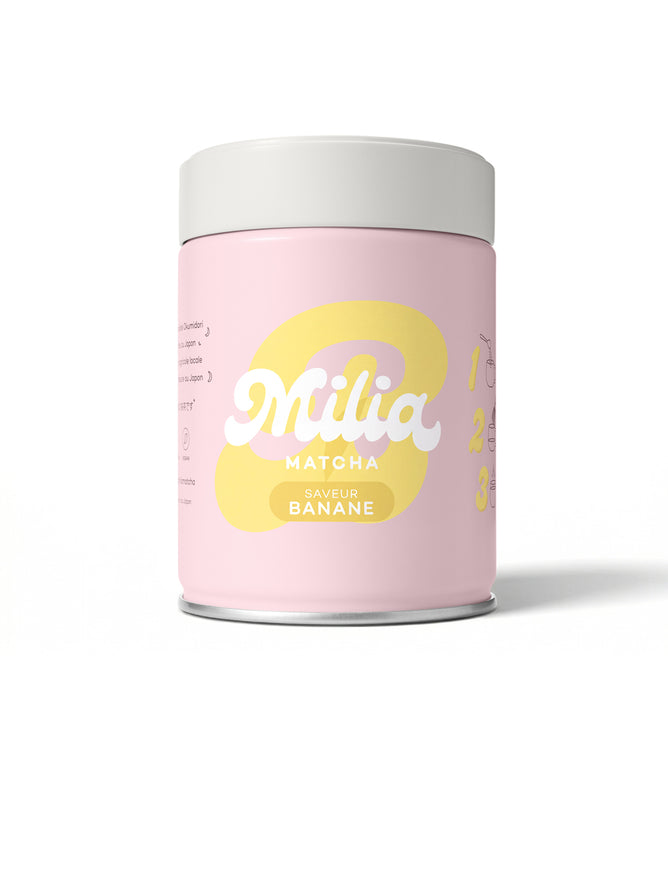
Ceremonial Matcha
Banana
100G

Ceremonial Matcha
Cherry
30G

Ceremonial Matcha
Ceremonial
30G


