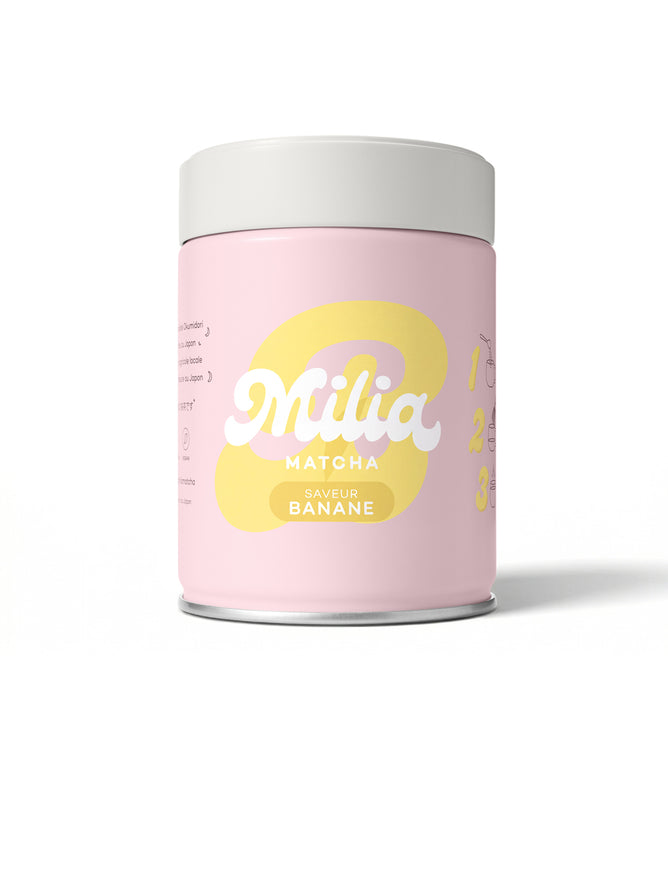
BACK IN STOCK

BACK IN STOCK
Discover our Cherry Matcha
Milia World

Our story
A family passion

our matcha
Japanese craftsmanship passed down from generation to generation

the benefits
A drink with multiple benefits.

the blog
Check out our news

Guide
Article published on November 6, 2026
The rare, naturally sweet tea variety behindmatcha Milia Matcha
Okumidori is a Japanese tea plant cultivar—that is, a variety selected for specific characteristics, just as there are different varieties of apples or grapevines. It is prized for two qualities: an intense green color once ground, and a mild, rounded flavor with very little bitterness. It is a rare cultivar: it accounts for only about 4% of Japan’s tea plants, whereas Yabukita, the standard variety, accounts for nearly two-thirds[1].
At Milia Matcha, this is the only cultivar we use for all of our matcha: 100% Okumidori, grown by the same family of farmers in Mie Prefecture, Japan, for over 60 years.
Okumidori was developed at the Kanaya Research Station in Shizuoka Prefecture (now part of NARO, the National Agricultural Research Organization of Japan) through a cross between Yabukita and a local tea plant from Shizuoka. It was officially registered in 1974 under number 32 in the Japanese Tea Cultivar Register[2][3].
Its name already tells us something about it: “oku” is the prefix given to late-season varieties, and “midori” means “green.” It is a late-season cultivar: its first shoots appear about ten days after those of the Yabukita, and it is harvested about a week later, when the leaves have taken on that particularly deep green color found in the powder[3].
Not all cultivars are created equal when it comes to matcha. Some have been selected for their cold tolerance, others for their yield, and still others for their flavor profile. Okumidori is recognized in the Japanese tea industry for two particularly sought-after qualities: a bright green color once ground, and a mild flavor profile, with a bitterness that is significantly more subtle than that of the most common cultivars. It also responds very well toshading, the process that concentrates L-theanine in the leaf. This is why it is especially prized in Japan for shaded teas: tencha, used to make matcha, and gyokuro.
Further Reading
Why choosing a good matcha cultivar is important
When prepared properly, Okumidori matcha is distinguished by its smoothness, its round and creamy texture, its lack of bitterness, and its naturally sweet notes. The official description of the cultivar refers to an aroma that is “fresh and clean, without any flaws or harshness.”[3]
This is a real advantage for people who are new to matcha and might be put off by the bitterness or the very pronounced grassy notes found in some products. Okumidori offers a more approachable experience, while retaining the rich aroma and finesse of a high-quality matcha.
The perceived bitterness of matcha depends on several factors that combine: the catechin composition specific to the cultivar, the intensity of shading before harvest, the timing of the harvest, and the balance with amino acids (including L-theanine), which soften the perception on the palate.
Okumidori has a genetic advantage in this regard. At Milia Matcha, this smoothness is enhanced by two cultivation practices unrelated to the cultivar itself: a long shading period of three to four weeks, and the exclusive use of the year’s first harvest (ichibancha), which is the most tender and least astringent.
Our matcha is grown in Mie Prefecture, a historic tea-growing region that is less well-known to the general public than Uji or Kagoshima, but is Japan’s third-largest tea producer and the leading producer of shaded teas such as kabusecha. We have been working with the same family of tea growers there for over 60 years on a farm spanning more than 20 hectares.
Cultivars
Two Japanese tea varieties, two profiles: taste, early maturity, role in plantations, and uses
| Criterion | Okumidori | Yabukita |
|---|---|---|
| Taste profile | Mild, full-bodied, slightly bitter | More vegetal, with a more pronounced bitterness |
| Cycle | Late | Average |
| Share of Japanese tea plantations | ≈ 4 % | ≈ 67 % |
| Typical Use | Tencha (matcha) and premium gyokuro | Very versatile: sencha, green tea, standard matcha |
Yabukita is by far the most widely planted cultivar in Japan, across all uses: approximately two-thirds of the total area, according to the Japanese Ministry of Agriculture[1], and 67.6% of the area covered by registered cultivars, according to a 2023 academic review[4]. It is the high-yield cultivar, selected for its versatility and productivity. Okumidori, planted more than fifteen times less frequently, is the choice of a few growers who specifically seek sweetness and color.
Saemidori is another cultivar renowned for its mildness, often mentioned alongside Okumidori in high-end matcha. Both were selected through the same research program and share a low-bitterness profile and a beautiful color. The main difference lies in their harvest cycles: Saemidori is an early-harvest variety, while Okumidori is a late-harvest variety. In terms of flavor, the distinction lies in the texture and depends heavily on the terroir and the growers’ expertise. At Milia Matcha, we chose Okumidori for its consistency, harvest after harvest, from the farm we work with in Mie.
Okumidori accounts for only about 4% of Japan’s tea-growing area[1], far behind Yabukita. Furthermore, most matcha sold is a blend: several cultivars, often from different farms, are mixed together to maintain the same taste and price from one harvest to the next. A 100% Okumidori matcha from a single farm therefore remains an exception.
We chose the Okumidori cultivar specifically for its mildness and low bitterness. This choice is consistent with our mission: to offer a matcha that is accessible, well-balanced, and a pleasure to discover—without compromising on quality.
Frequently Asked Questions
The cultivar itself is not a guarantee of whether a product is organic or non-organic: it is simply a variety of tea plant, regardless of the cultivation method. Matcha Milia Matcha is not certified organic, but each batch is analyzed by an independent laboratory (Eurofins) and has been found to contain no detectable pesticide residues. We explain this in our article “Organic Matcha and Pesticide-Free Matcha.”
Our matcha is made from the Okumidori cultivar, which is 100% Japanese. We source it exclusively from a family of producers in Mie Prefecture.
Yes: its mildness and subtle bitterness make it an excellent introduction to matcha. We also offer a range of flavored Okumidori products, which help you get used to the taste of matcha through familiar flavors.
[1] Japanese Ministry of Agriculture, Forestry, and Fisheries (MAFF) (2024). The State of the Tea Industry – Cultivated Areas by Cultivar, 2023 Data. https://www.maff.go.jp/j/seisan/tokusan/cha/
[2] Yagi, C., Ikeda, N., & Sato, D. (2010). Characteristics of eight Japanese tea cultivars. Fruits and Nuts, F_N-15. University of Hawaiʻi at Mānoa, CTAHR. https://www.ctahr.hawaii.edu/oc/freepubs/pdf/F_N-15.pdf
[3] O-CHA NET, Shizuoka Tea Association. “Okumidori” (おくみどり) cultivar profile. https://www.o-cha.net/teacha/hinshu/okumidori.html
[4] Kubo, N., Yokoyama, H., & Ohgushi, T. (2023). Tea cultivars in Japan. In Natural Products in Beverages (Reference Series in Phytochemistry). Springer. https://doi.org/10.1007/978-3-031-04195-2_25-1