


BACK IN STOCK

BACK IN STOCK
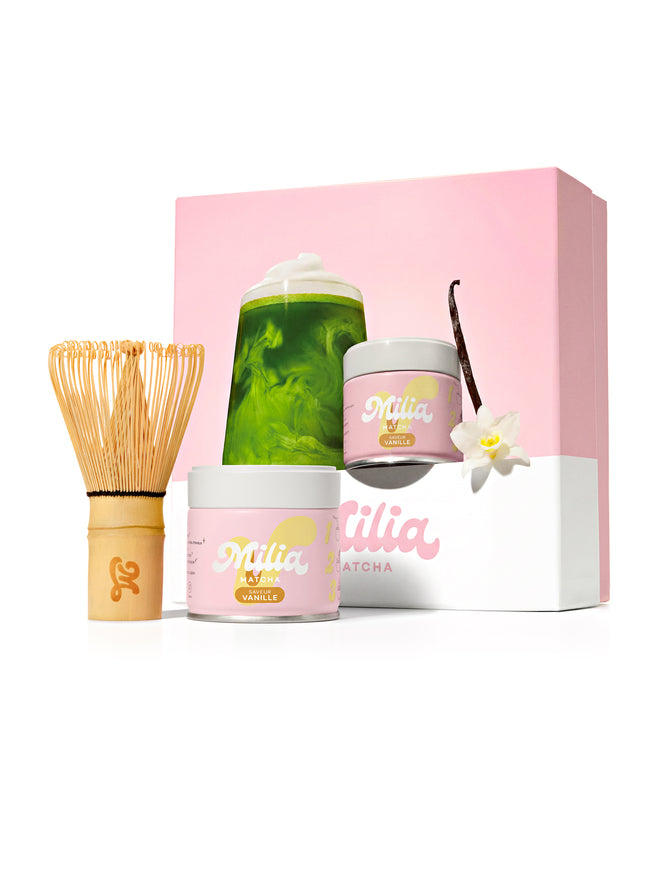
Discover our Vanilla Matcha
Milia World

Our story
A family passion

our matcha
Japanese craftsmanship passed down from generation to generation

the benefits
A drink with multiple benefits.

the blog
Check out our news

Guide
Article published on 18 March 2026. Reading time: 10 min
Japanese matcha is now one of the most sought-after ingredients in cafés, bakeries, and wellness routines. Its vibrant green colour catches the eye, its flavour captivates, and its health benefits are winning over more and more people. Yet behind this popularity lies an agricultural product of great complexity, the result of a demanding craft that has been passed down for over 800 years.
This comprehensive guide to matcha answers all your questions: what it really is, its history, how it’s grown and processed, its health benefits, and—most importantly—how to choose and prepare matcha properly to get the most out of it.
Written by the team at Milia Matcha, a French brand specialising in premium Japanese matcha, this guide has one goal: to give you all the information you need to understand, choose, and prepare your matcha with confidence.
The word matcha (抹茶) comes from Japanese: ma (抹) means “ground” and cha (茶) means “tea.” Literally, it refers to a green tea ground into a very fine powder, made from leaves cultivated according to a specific protocol and then slowly ground between granite millstones.
Matcha differs from other teas primarily in the way it is consumed. Unlike traditional green tea, which is steeped, matcha is mixed directly with water and then drunk as is. This means that the entire leaf is consumed, not just the infusion. This difference may seem subtle, but it has a significant impact on the concentration of bioactive compounds. Indeed, as Joanna Kochman and her team pointed out in the scientific journal Molecules (2020), consuming the whole leaf allows for the absorption of far more catechins, L-theanine, and antioxidants than the infusion alone.
Beyond offering a different way to enjoy tea than what we’re used to, it is this unique characteristic that accounts for matcha’s distinctive texture, its intense aroma, and its high content of bioactive compounds.
Before it is ground, the leaf used to make matcha goes by another name: tencha. This is a little-known step, yet it is key to understanding what sets true matcha apart from ordinary green tea powder.
To become tencha, the leaves are grown in the shade, the young shoots are selectively harvested, the leaves are quickly steamed to halt oxidation, dried, and then the stems and veins are carefully removed. It is only at this stage—and only after being ground between millstones—that tencha becomes matcha.
Many powders sold under the “matcha” label around the world are not made from tencha. They are simply ordinary green tea leaves that have been mechanically ground into powder: they have a dull colour, a coarse texture, and a bitter taste. Recognising real matcha starts with knowing what tencha is.
Matcha is produced from Camellia sinensis, the tea plant. But within this species, it is the cultivars—varieties that have been carefully selected and cultivated—that determine the quality, colour, and flavour profile of matcha.
The three main varieties used for matcha are:
The history of matcha began in China between the 7th and 13th centuries. During the Tang and Song dynasties, the Chinese produced tea compressed into cakes, which were ground into powder and then whisked into hot water: this was the direct predecessor of matcha. In the 12th century, the Buddhist monk Eisai brought this practice to Japan, where it became deeply rooted in the culture and formed the foundation of the tea ceremony, known as chanoyu.
In 1391, a decisive event changed the course of tea history. Emperor Hongwu of the Ming Dynasty banned powdered and cake tea throughout China, deeming them too elitist. China then abandoned steaming in favor of pan-firing, giving rise to the teas we know today: Longjing, Oolong, white tea…
The art of making powdered tea disappeared from China within a single generation.
Japan, for its part, carried on regardless. Unfazed by this imperial decree, it retained the steaming method, refined its tea culture over the centuries, and preserved an art that the rest of the world had abandoned. That is why, today, matcha is an exclusively Japanese speciality—not because Japan invented it, but because it is the only country to have preserved it.
Matcha is not simply powdered green tea. It is a tradition dating back more than 800 years, one that Japan is the only country in the world to have preserved, and it is this historical distinction that makes it unique and irreplaceable.
Understanding how matcha is made means understanding why its quality can vary and why high-end matcha is worth the price.
About three to four weeks before harvest, the tea plants are covered with nets or tarps to shield them from direct sunlight. This step, known as shading, is one of the most critical in the entire production process.
By depriving the leaves of light, a series of natural reactions is triggered: the plant increases its chlorophyll production (hence the intense green colour), slows its growth, develops a milder flavour at the expense of bitterness, and finally concentrates L-theanine. Shade cultivation triggers a biochemical mechanism that limits the conversion of L-theanine into catechins, leading to a significant accumulation of this compound in the final leaf, as demonstrated by Joanna Kochman and her colleagues in a review published in 2020. It is thanks to this technique that matcha develops its smooth texture and characteristic flavour, while offering a profile rich in L-theanine, which promotes relaxation and concentration.
It’s common to read that premium matcha is harvested by hand. It’s an appealing image, but the reality is more nuanced: harvesting is now almost exclusively mechanised, even for high-end matcha. Hand-picking requires a large, highly experienced workforce, making it rare and very expensive. These exceptional, hand-picked matcha varieties remain in Japan and are reserved for traditional tea ceremonies.
What truly sets a premium matcha apart is not the harvesting method, but rather the harvest grade, the cultivar, the richness of the soil, the duration of shading, and the care taken at every stage of production throughout the year. The first harvest (ichibancha, late April–May) yields the leaves richest in amino acids, with the mildest and most refined flavour; it is the only harvest that produces ceremonial-grade matcha. Subsequent harvests produce matcha of intermediate quality, followed by a more bitter culinary-grade matcha, suitable for baking.
Some matcha sold under the label "Ceremonial"—which is supposed to refer to the first harvest—actually comes from the second or even the third harvest, because those leaves are less expensive to purchase. This shows just how much the origin and harvest grade influence the taste and quality of matcha.
After harvesting, processing follows a precise sequence. The leaves are sorted, then steamed at 100 °C to halt oxidation and lock in the green colour. They are then dried and stripped of their stems and veins to retain only the finest and most tender parts. At this stage, the leaf has become tencha and can be vacuum-sealed and stored for several years before being ground. Finally, to ensure the quality of the matcha, the tencha must be stored for at least 4 to 6 months before being ground. Therefore, promoting “new matcha” as early as April or May is not a reliable indicator of quality.
Grinding is the final and most delicate step: the tencha is slowly ground between two granite millstones, a process that takes about an hour to produce just 30 grams of powder. This slow grinding is essential: it prevents overheating, which could alter the aromas, and produces an extremely fine powder. It is at this precise moment that tencha becomes matcha.
Sources: Kochman et al. (2021), Toniolo et al. (2025), White et al. (2025)
Matcha may be processed in Japan but made from leaves grown in China or elsewhere. It can then be legally marketed as "Japanese matcha," even though it is not produced in Japan.
True Japanese matcha means that every step of the process—from cultivation to grinding—takes place in Japan. That’s why it’s essential to make sure that all of these steps are carried out in the same location in Japan when choosing your matcha.
Because you consume the entire leaf, matcha contains bioactive compounds at levels far higher than those found in a traditional brewed tea. Three benefits have been particularly well documented.
Matcha contains both caffeine and L-theanine. Caffeine provides stimulation, while L-theanine tempers its effects and promotes a state of calm alertness. The synergy between caffeine and L-theanine in matcha was documented in a review by Sokary and colleagues, published in 2022 in Current Research in Food Science: this combination produces a more stable and longer-lasting stimulating effect than caffeine alone, without the jittery spikes associated with coffee.
Matcha is particularly rich in catechins, notably EGCG (epigallocatechin gallate), one of the most powerful antioxidants known. Its concentration is significantly higher than that of brewed green tea, since the entire leaf is consumed. These compounds help protect cells against oxidative stress and support the body’s natural defences.
According to a study by Rovaldi and colleagues (International Journal of Molecular Sciences, 2025), EGCG neutralizes the free radicals responsible for skin aging: wrinkles, loss of elasticity, a dull complexion, and dark spots are all signs that these molecules accelerate over time.
Recent research also shows that catechins help reduce sebum production and improve skin elasticity when applied regularly (Zheng, Antioxidants, 2024). According to Rovaldi (International Journal of Molecular Sciences, 2025), these same molecules show promising effects against acne, psoriasis, and skin irritations.
The matcha market has grown significantly in recent years, and with it, confusion. Here are five criteria that will help you distinguish high-quality matcha from an ordinary product.
Colour is the first indicator: high-quality matcha is a bright, vibrant green. A dull, khaki, or yellowish hue indicates poor quality, a late harvest, or an oxidised product.
Origin is key: make sure the matcha is 100% produced in Japan, from cultivation to grinding. As this market grows, there is an increasing number of matcha products processed in Japan using leaves grown elsewhere; while this practice is legal, it results in a less authentic, lower-quality product.
Harvest grade: A premium matcha must come from the first harvest (ichibancha), which takes place in late April–May. In fact, the concentration of L-theanine varies by grade. It gradually decreases from the first ceremonial harvest to food-grade matcha as the leaves age. This direct relationship between leaf maturity and its chemical profile has been precisely documented and quantified in matcha grown in the Uji region. Toniolo and his colleagues used NMR spectroscopy to analyse leaves at different stages of development, demonstrating how the concentrations of catechins, L-theanine, and other key compounds change as the plant grows (A comparative multianalytical approach to the characterization of different grades of matcha tea, 2025). These scientific findings confirm that the selection of young leaves is not merely a tradition—it is essential for producing matcha that is rich in flavour and nutrients.
The cultivar: Specifying the cultivar used (Okumidori, Saemidori, Yabukita) is a sign of professionalism and traceability. Furthermore, a single-blend matcha—that is, one made from a single cultivar without any mixing—guarantees optimal traceability and a more consistent quality.
Testing and traceability: Organic certification is costly and difficult to obtain for small, artisanal Japanese farms. Independent test results published by the producer, such as Eurofins certifications, often provide more reliable assurances than mere claims of organic status.
Further Reading
The organic certification for matcha: What does it really mean?
Making matcha is simple, but a few basic rules make all the difference.
You'll need about 1 to 1.5 g of matcha (one level teaspoon), 70–80 ml of water at 70–80 °C, a bowl or a large mug, and ideally a bamboo whisk (chasen) and a fine sieve.
Start by sifting the matcha directly into your bowl—this prevents clumps and ensures a smooth texture. Then pour in water at 70–80 °C. Never use boiling water: at temperatures above 80 °C, matcha develops a pronounced bitterness and some of its aromatic compounds break down. Finally, whisk vigorously in a “W” pattern for 20 to 30 seconds, until a fine, even foam forms on the surface. Drink immediately.
Prepare the matcha with just 30–40 ml of water, then add hot or cold milk, depending on your preference. Oat milk and hazelnut milk pair particularly well with the vegetal notes of matcha.
Dissolve the matcha in a little lukewarm water, then pour it over ice cubes. Add plant-based milk to make an iced matcha latte.
Matcha is sensitive to light, air, heat, and humidity. Seal the package tightly after each use and store it away from light and heat sources. When stored properly, matcha retains its freshness and intensity for several weeks to several months, depending on the packaging.
Further Reading
How to Store Matcha: Best Practices
Matcha is much more than just a wellness trend. It is a beverage rooted in over 800 years of Japanese history and culture, enjoyed today in traditional ceremonies as well as in cafés around the world as a latte, iced matcha, or served straight.
Behind every cup lie tangible, well-documented benefits: gentle energy without jitters, an exceptional concentration of antioxidants, and recognised effects on mental clarity—benefits you’ll experience no matter how you enjoy it.
Finally, as Borsato (2024) points out, chanoyu—the Japanese tea ceremony—transforms every gesture involving matcha into a mindful ritual, blending ancestral expertise with Zen philosophy.
Understanding where it comes from, how it’s grown and processed, and what sets true matcha apart from ordinary green tea powder—that’s what makes all the difference when it comes to fully appreciating it, cup after cup.
Would you like to put these tips into practice?
Frequently Asked Questions
No. A cup of matcha contains about 30–70 mg of caffeine, compared to 80–120 mg in a cup of coffee. But the effect is different: L-theanine moderates the stimulating effect of caffeine, making it milder and longer-lasting.
Excessive bitterness is often a sign of a late harvest, inferior quality, or water that was too hot during preparation.
Ceremonial matcha comes from the first harvest and is intended to be drunk as a beverage. Culinary matcha, made from later harvests, is more bitter and stronger, making it ideal for baking, where other flavours come into play.
1 to 2 cups a day is a reasonable amount for most adults.
Yes, but it doesn't make much economic sense: the subtle flavour of a premium matcha is hard to detect once it's mixed with other ingredients. Save it for drinking on its own and opt for a culinary matcha instead.
Sources:
Borsato, M. (2024). Kaiseki, matcha, wagashi: Taste in the Japanese Tea Ceremony. Aesthetica Preprint, 126, 21–33.
Kochman, J., Jakubczyk, K., Antoniewicz, J., Mruk, H., & Janda, K. (2020). Health Benefits and Chemical Composition of Matcha Green Tea: A Review. *Molecules*, 26(1), 85.
Rovaldi, E., Di Donato, V., Paolino, G., Bruno, M., Medei, A., Nisticò, S. P., Pellacani, G., Kiss, N., Azzella, G., Banvolgyi, A., & Cantisani, C. (2025). Epigallocatechin Gallate (EGCG): An Essential Molecule for Human Health and Well-Being. International Journal of Molecular Sciences, 26(18), 9253.
Sokary, S., Al-Asmakh, M., Zakaria, Z., & Bawadi, H. (2022). The therapeutic potential of matcha tea: A critical review of human and animal studies. Current Research in Food Science, 6, 100285.
Toniolo, C., Patriarca, A., De Vita, D., Santi, L., & Sciubba, F. (2025). A comparative multianalytical approach to the characterization of different grades of matcha tea (Camellia sinensis (L.) Kuntze). Plants, 14(11), 1631.
Zheng, X., Zhang, X., Gao, H., Huang, L., Ye, J., Ye, J., Lu, J., Ma, S., & Liang, Y. (2024). Green Tea Catechins and Skin Health. Antioxidants, 13(12), 1506.
THE ESSENTIALS
Vanilla

THE ESSENTIALS
Ceremonial


